NEO-GEO Nostalgia
I’m not lucky enough to have a NEO-GEO floating about in the rumpus room (obviously, I really wish I did), and until recently I don’t think I’d ever even seen one. I am interested in lesser-known video gaming lore, though, and have watched many a video and read many an article on SNK’s surprisingly flat box of wires and circuit boards. I’ve also played ports of the various Metal Slug, Fatal Fury and The King of Fighters games that have sprung up on other consoles throughout the years, so it’s not like I’m completely clueless about the world of Shin Nihon Kikaku, just mostly clueless.
Kizuna Encounter: Super Tag Battle is a game that kept coming up in my research for articles and scripts I was writing. Most recently, it came up in my research for my as-yet unreleased Alien/Predator video game ranked list I put together for TripleJump. You see, a 2010, unlicensed mobile title called Predators: The Great Hunt swiped its backgrounds directly from SNK fighting games. I was first made aware of this when a contributor on tvtropes.org pointed out that the stage background from Krizalid’s arena from The King of Fighters ’99 was used, and this got me interested enough to do some sleuthing myself. Through a bit of reverse image searching I was able to identify a background from Kizuna Encounter: Super Tag Battle and, once I’d recovered from my distress at the brazen plagiarism on display, was yet again reminded just how frickin’ awesome this NEO-GEO tag team fighter looked.

Fast forward to the other day, and I’m needing to think of a game that was released on a non-Sega, Nintendo, Sony, or Microsoft console (and wasn’t Metal Slug – long story) that I could nominate into the Video Game Hall of Fame, and I thought “maybe it’s time to see if that Kizuna Encounter thingy plays as good as it looks”. A bit of cheeky emulation later and I’m glad to report that it does indeed play wonderfully, and is an all-round tasty slice of fast-paced, one-on-one, weapons-based fighting action.
Kizuna Encounter: Super Tag Battle is a sequel to another NEO-GEO fighter called Savage Reign, and lots of its controls and mechanics are lifted from Real Bout Fatal Fury. However, each combatant has their very own deadly weapon and the tag team mechanic is placed front and centre. It’s the tag team thing that really makes Kizuna Encounter stand out, as you’ll lose the bout if one of your characters goes down regardless of how much health your other character has left, and tags can only be made in a certain indicated section of the arena. This means that new tactics open up, like using quick tags to isolate your opponent, and dramatic struggles to get back to your tag partner become commonplace when things get dangerous. Combatants can regain some health while tagged out, too, so the game definitely encourages players to engage with the tag mechanic. I also like how your tag partner is visible in the background at all times, and will appear raring to go or sagging and depleted, depending on how much of a beating they’ve taken.

I’m far from an authority when it comes to fighting games. I’m more interested in them for the cool characters they can offer and the spectacle they can present than I am for technical moves and combos. I button mash, I rarely block, and sometimes I even play them on easy mode. With all that out in the open so that you can take my opinion with the recommended amount of salt, I did really enjoy Kizuna Encounter. It was easy to pick up and within a few bouts I was able to unleash some pretty cool moves. There’s also plenty to master, and while I never got anywhere near anything resembling “mastery” during my time with the game, I definitely got better with a couple of roster members.
Speaking of the roster, it’s pretty bombastic. I had a lot of fun playing as Max Eagle, the big, axe-wielding American wrestler with a positive attitude, and some of the character designs are super-cool. Sho Hayate is the slick, hero type character, Gordon Bowman looks like an overweight M Bison cosplayer, and rollerblading clown-punk, Joker, could be a Streets of Rage mini-boss. There are even a pair of Mortal Kombat-style pallet-swapped ninja in Mezu and Gozu, the latter of which has some pretty nifty fire-based moves.
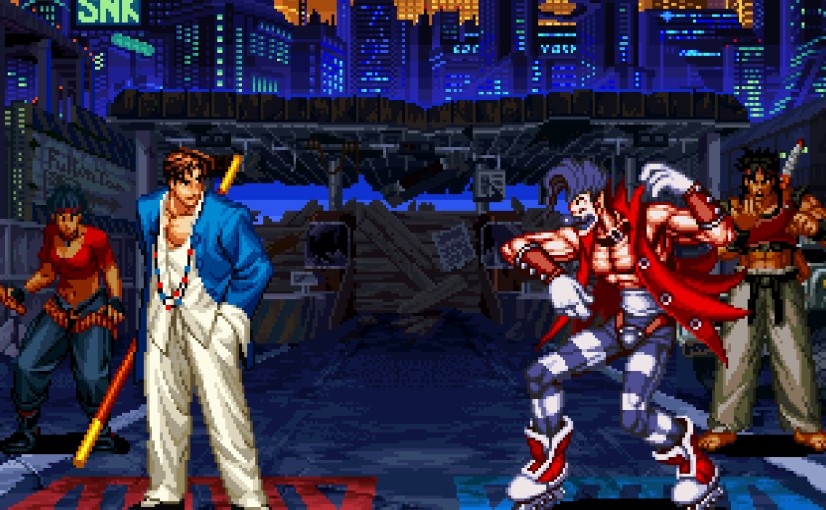
The two new characters that were added since the previous game are probably the highlights, though, as Rosa is an eye-catching and badass katana-wielder and staff-fighting police detective Kim Sue-il is the epitome of effortless suave. They both look great against the game’s stunning backdrops, and add to the overall vibe of urban cool.
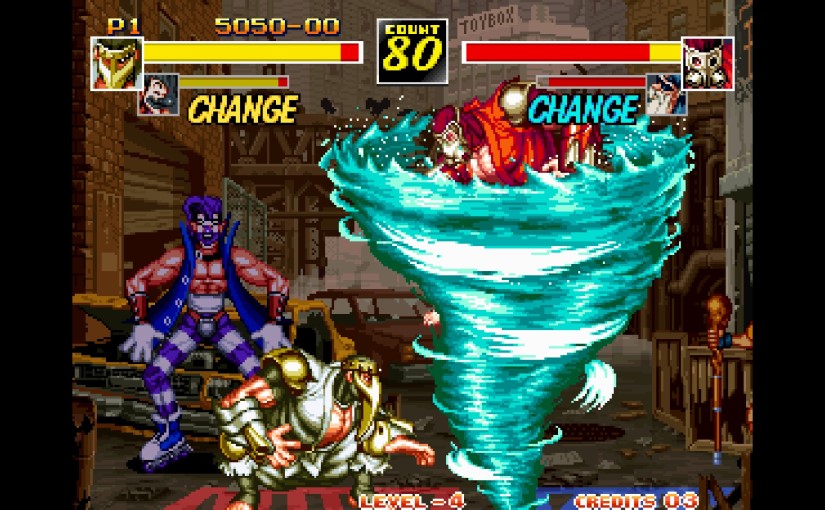
Those stunning backgrounds were what brought me to the party, though, being a shallow, visual kind of fellow who likes looking at cool things. The pixel art on display is phenomenal, and every stage oozes that classic SNK artistry. Glittering skyscrapers viewed from below, sprawling cityscapes seen from above, run-down alleyways, cloudy docks, neon signs, grimy overpasses, and more all await those who are ready to brave the Battle of the Beast God Tournament, and every stage is fantastically atmospheric in its own way. This includes the final arena, a sinister shrine filled with eerie statues inhabited by the final boss, mysterious crow helmet-wearing bad guy, Jyazu. That’s the background that was nicked by the Predator game, by the way.
Like I said, I’m no authority on fighting games, or on the NEO-GEO, or on SNK in general, but I do know what I like and I like Kizuna Encounter: Super Tag Battle, and I wanted to write about it so that its wonderful pixel art could grace my humble web page. SNK really knew their stuff when it came to chucking pixels on a screen, eh?
Played Via Emulation.