
Sylux, Psychics, and Sidekicks
There’s something about the Metroid series. It’s a franchise that I’ve been interested in for a long time but didn’t leap into until Metroid Dread. Sadly priced out of most of the earlier entries into the series, I did consume lots of content about Metroid lore and history following my introduction to Samus Aran’s atmospheric adventures. I then jumped into Metroid Prime Remastered, and have now finally finished my third game in the franchise with the recently-released Metroid Prime 4: Beyond. I wrote about Metroid Dread here, and did a game diary on Metroid Prime Remastered here.
Nintendo’s Alien-inspired sci-fi series is fascinating to me, as its mixture of the Japanese giant’s bright and breezy style and the horror and isolation taken from Ridley Scott and James Cameron’s pair of masterpieces creates a beguiling whole. Some of the enemies are pretty creepy, and many of the bosses are incredibly monstrous, but much of the actual horror found in Metroid is inferred from background details and logbook entries. Instead, Samus’ adventures are more tightly focused on atmosphere and that all-important sense of isolation.
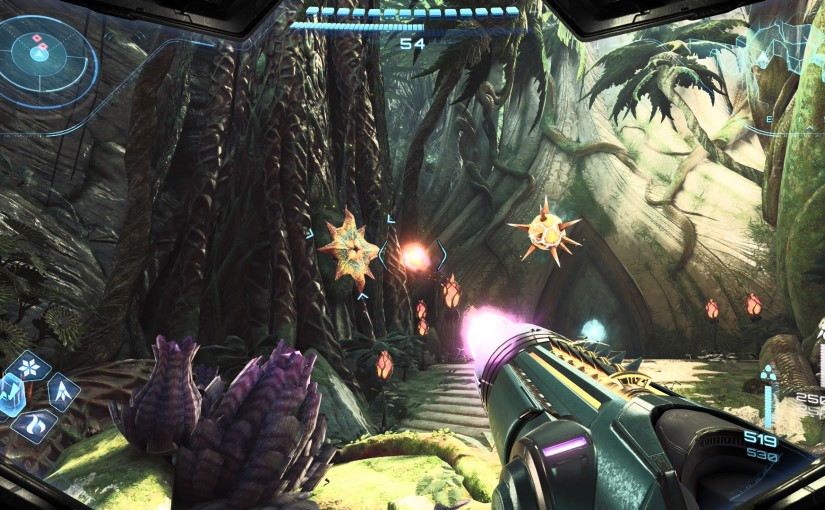
So, why does Metroid Prime 4: Beyond have a super-talkative companion and radio buddy, then? Honestly, I don’t think the companion characters are that much of an issue. Mackenzie, the one that everyone has the specific problem with, is kind of annoying at first, but he’s okay in the long run, and I always felt that the side-view Metroid games did the isolation thing better anyway. If you’re put off trying Metroid Prime 4: Beyond because of the complaints you’ve heard about Mackenzie and pals, don’t be, you and Samus will still have plenty of chances for alone time in the depths of some godforsaken heck-hole, way out of radio contact from your bespectacled chaperone.
I actually managed to 100% my play-through of Metroid Prime 4: Beyond. The item completion kind of happened naturally, and then I used the internet to find the last few scans before I took on the final area. I feel no shame at this; I don’t have time to piss about aimlessly looking for something called a “blow hopper” that spawns in a single location beneath a volcano, I had to ride my motorcycle around a desert smashing through a seemingly unlimited phalanx of sparkly green crystal formations. That was my way of introducing the other biggest annoyance I’ve seen people bring up about this game, by the way; the great crystal hunt. Again, I didn’t mind it, and spent an hour before my push into the game’s final sequence riding around in a zen-like state and mopping up the last of those crystals in one fell swoop. It was okay, and it didn’t take too long, even with Mackenzie sticking his oar in over the radio link from time to time.
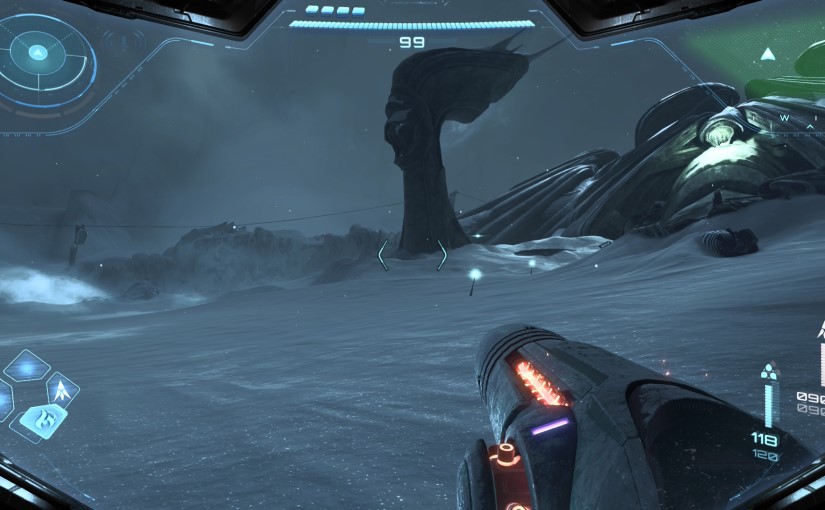
Right, enough babbling, let’s start the “review” already. Metroid Prime 4: Beyond looks phenomenal, and uses its rich, mystical colour palette to paint a lively and awe-inspiring fantastical world. At times it reminded me of the awesome sci-fi art of the sixties, seventies, and eighties by the likes of John Harris and Manchu, at times it reminded me of James Cameron’s Avatar series of movies, and at times, yes, it did remind me of Halo. It does have its own thing going on though, and the environments look incredible whether you’re overlooking sweeping vistas and epic sky-boxes in the desert hub area or booking it through tight corridors filled with secreted alien goop at the bottom of a vast mining complex.
I was playing on the Switch 2 in Quality Mode and the game consistently looked fantastic with no noticeable drops in performance. Occasionally I would notice a few pixelated details though, and mostly on the helmet visors of the small squad of Galactic Federation soldiers Samus encounters, or on the hammerhead shark-like face of the super-beefy allied android, VUE-995. On the rare occasions when the squad’s visors open and you see their actual faces, there are no such issues and there are some high quality facial animations on show, but the fuzziness on their helmets is noticeable on occasion and can be a minor immersion killer. For the most part though, this is a mighty fine looking game.
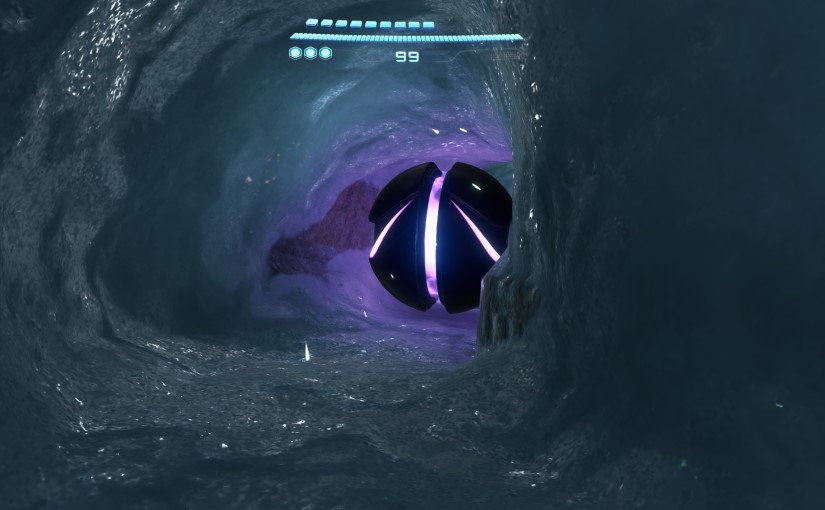
The gameplay is also on point. There’s nothing very new to report if you’ve already played any of the Metroid Prime games (meaning that the new “psychic” powers Samus attains aren’t actually very different from her usual abilities in practice) but if you’re new to the Metroid party, expect a super-smooth FPS experience with a slower, considered pace, a fair helping of puzzles and back-tracking, and a high-concept sci-fi feel, favouring elemental-based weapons over Aliens-style modern solid round firearms. Players are expected to engage with the world by way of scanning critters, lore items, and enemies, and by exploring every nook and cranny for upgrades. Puzzles range from simplistic to devious, but progress-blocking brainteasers never offer up too much of a problem, meaning that the pace is rarely harmed.
Comparing Metroid Prime 4: Beyond to Metroid Prime Remastered, I’d say that this game is more straightforward in its level design. There are also fewer aggravating enemies, and most players will have an easier time with the general aggressive flora and fauna (as well as the mysterious “grievers”) that make up most of the combat. One or two of the bosses put up a legitimate fight, and the final confrontation is suitably challenging, but overall, Beyond is an easier game than Prime Remastered. I didn’t mind this at all, as I did find that Prime Remastered started to wear on me at times, and the fission metroids that were encountered regularly towards the end of that game were a frustrating pain-in-the-arse to fight. There’s nothing like that here, and this is alright with me.
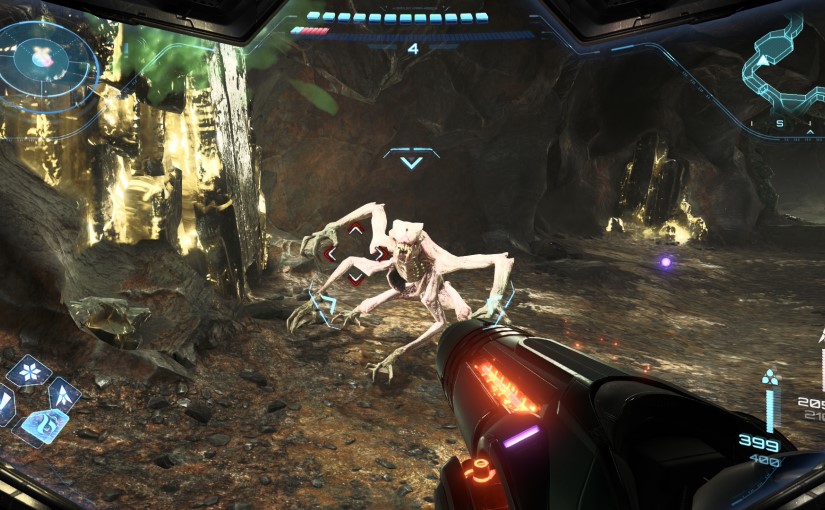
The weapons and gadgets are as fun to use as always. By collecting enough of the infamous green crystals Samus can upgrade her basic cannon, and this upgraded version feels a lot more satisfying to use. The super-charged fire shot is also a lot of fun to unleash, and the super-charged thunder shot is an absolute dream, sending a devastating beam of erratic, electric energy that homes in on every enemy nearby and erases them in a visual feast of spectacular obliteration. It almost feels overpowered, but you’ll have earned it by the time you get it, and it uses a fair chunk of ammo, too.
Not that I ever really had to worry about ammo. Well, not until the very last battle at least where I was spamming the final suit’s overshield ability which inexplicably uses your missile supplies to power up. Metroid Prime 4: Beyond locks its hard difficulty until you’ve completed the game on normal. I haven’t tried it yet, but apparently it causes save points to only restore health instead of health and ammo, so I suspect that this, along with the generally tougher enemies, means that ammo conservation comes into play a lot more if you’re brave enough and time-rich enough to go through another play-through on hard mode. I won’t be doing it, I’ve got other games to play. Those last few bits of concept art in the gallery will have to stay locked, I’m afraid.
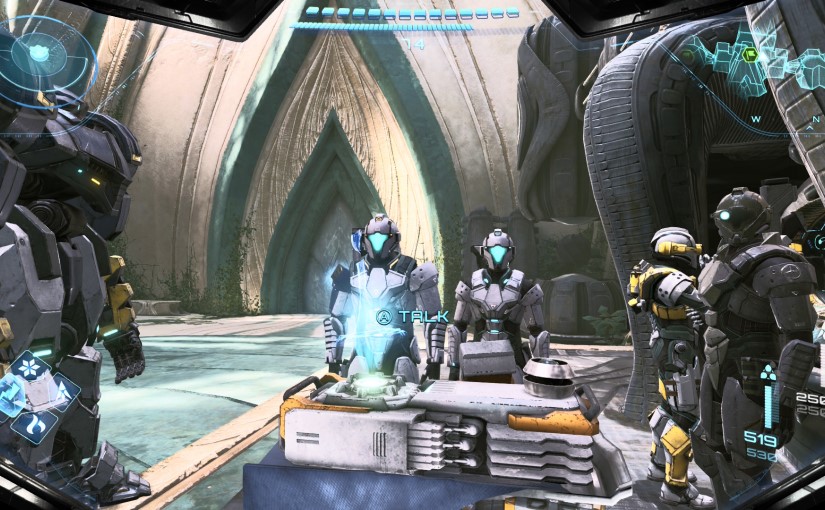
I really enjoyed Metroid Prime 4: Beyond. Its stellar art direction, memorable musical accompaniment, and tried and tested gameplay and progression made for a very satisfying and compelling experience. I found the supporting cast likeable (even Mackenzie by the end) and they were used sparingly enough that the sense of isolation still had its time to shine. I enjoyed the boss fights and felt comfortable with the controls, and I only occasionally got a bit exasperated with the back-tracking and the more fiddly areas (like some of the morph ball sections in the powered-up bike factory).
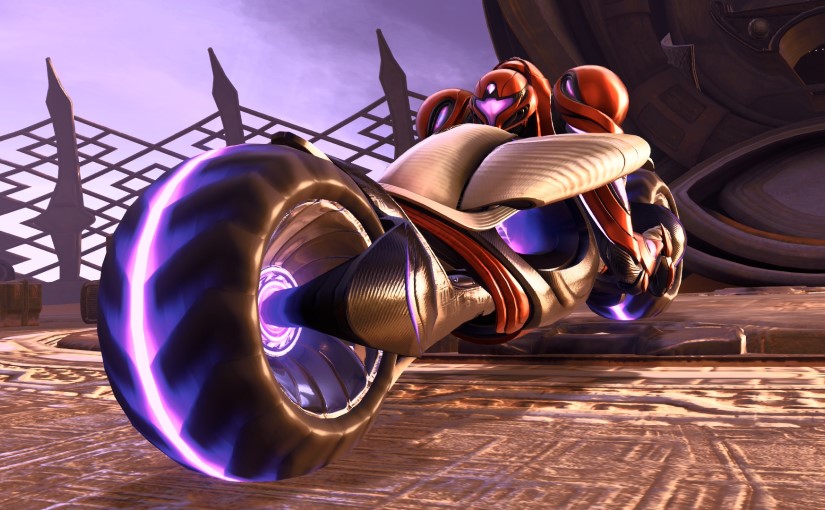
Speaking of bikes, I’m a sucker for a sleek, futuristic motorcycle design, and Metroid Prime 4: Beyond does not disappoint in that regard. Vi-O-la, as Samus’ glamorous, metallic steed is known, is a highlight of the game, even if you’ll mostly be riding it around empty desert hunting down those blasted green crystals. I like a sci-fi bike, and Vi-O-la is a sci-fi bike that I like.
As a self-confessed Johnny-come-lately to the venerable Metroid franchise, Metroid Prime 4: Beyond gets an enthusiastic thumbs-up from me. Sleek, slick, and exceedingly pretty, Samus’ most recent outing didn’t outstay its welcome and kept me interested throughout, never once becoming a chore, even when I was filling the crystal receptacle so that I could get a special memory fruit or whatever that bit was all about. Look, just stop being such a blow hopper and give it a try, okay?
Leave a Reply